
 MAJOBA on Facebook

Magnetic Bookmarks
- "Floral year"
- Seaside
- Germany
-
Wide World
- Abu Dhabi
- Andorra
- Argentina
- Australia
- Austria
- Azores
- Belgium
- China (PRC)
- Costa Rica
- Crete
- Cuba
- Czech Republic
- Denmark
- Dominica
- Dubai
- Egypt
- El Hierro
- England
- France
- Gibraltar
- Hawaii
- Iceland
- Ireland
- Italy
- Croatia
- La Gomera
- Lanzarote
- Latvia
- Madeira
- Marocco
- Mexico
- Moorea
- Netherlands
- New Zealand
- Norway
- Oman
- Patagonia
- Poland
- Portugal
- Rangiroa
- Rapa Nui (Easter Island)
- Samoa
- Scotland
- Spain
- Sri Lanka
- Sweden
- Switzerland
- Tahiti
- Tasmania
- Tenerife
- Türkiye
- USA
- Cabo Verde
- Fidschi
- Leisure Time
- Flowers
- Animals
- Christmas
-
Search terms A-Z
- Agriculture
- airplanes
- Antiquity
- Art
- Artcraft
- Autumn
- Books
- Bridges
- Buildings
- Bunt
- Castles
- Caves
- Chairs
- Christmas
- Cities
- Clefs
- Cliffs
- Clocks
- Clouds
- Deserts
- Doors
- Fest
- Figures
- Fishing
- Fog
- Forest
- Fountain
- Fruits
- Games / toys
- Gardens
- Gates
- Glacier
- Graves
- Harbour
- History
- Huts
- Instruments
- Islands
- Lakes
- Lighthouses
- Literature
- Market
- Means of transportation
- Megalithen
- Mills
- Monuments
- Moon
- Mountains
- Museums
- Mushrooms
- Natural Events
- Night
- Objects
- Palms
- Park
- Paths
- People
- Personalities
- Places
- Plants
- Points of Interest
- Pumpkins
- Rain
- Rainbows
- Religions
- Rivers / Creeks
- Rocks
- Ruins
- Sculptures
- Seashells
- Ships_boats
- Shoes
- Situations
- Snow
- Sports
- Spring
- Stars
- Steps
- Stones
- Sun
- Sunrises
- Sunsets
- Sunumbrellas
- Swimmingpool
- Symbols
- Tables
- Technology
- Towers
- Trains
- Trees
- Two
- Vulcanos
- Waterfalls
- Waves
- Weltraum
- Wiesen
- Wind
- Wind generators
- Windows
- Winter
- Work
- Z-Malstile
- Sets
- Motifs + their stories
- MAJOBA Booklets
- MAJOBA Audio
- Timeless Calendars
- Audio
- Stories Behind
- About the artist
- MAJOBA in the video
- MAJOBA on the spot
- Business customers
October 2026
- Holy Sara -
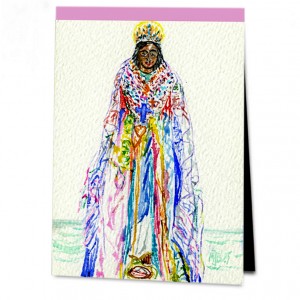
The Provençal coastal town of Saintes-Maries-de-la-Mer, on the southern edge of the Camargue, had long been familiar to me. As early as the late 1970s, my fellow student Jörg had spoken with great enthusiasm about the large, colourful Roma festival held there at the end of May. He had witnessed how the figure of their patron saint, Holy Sara, was carried in a long procession to the sea and gently bathed in salt water. “You simply must go there one day!” he had said. Others, too, had spoken fondly of it: of camping holidays along the wide town beach, of the white wild horses and the flamingos of the Camargue. And yet, this destination kept slipping from my mind – until years later, in Portugal, I was describing our return journey to my friend Renata, a route that would take us through La Mancha, along the Costa Brava and into Provence on our way north.
“You really must see the Black Madonna in the church of Saintes-Maries-de-la-Mer. You’ll love her.” In that very moment, everything returned: curiosity, wanderlust – and a strong desire to paint exactly this motif. Unfortunately, our time for this detour into the Camargue was very limited. As soon as we arrived in Saintes-Maries-de-la-Mer, I urged my husband, “Come, let’s go straight to the church.” It was late afternoon, mid-October, and yet the church was still quite busy. In a small chapel above the altar lie the relics of the three holy Marys; in the crypt beneath the altar are those of their servant, Holy Sara, who has been venerated as the patron saint of the Roma since the 15th century. She was the one I wanted to paint.
The vaulted space where her figure stands in one corner was bathed in a warm, subdued light – from a few ceiling lamps and numerous flickering candles. On the floor, on chests and small ledges, stood vases filled with fresh and artificial flowers. The walls were covered with portraits of believers and photographs of past processions. Fortunately, the room emptied quickly as the service began above me in the altar space. It must have been around six o’clock – I had one hour left before the church would close.
There was nowhere to sit, so I began to paint standing up. Before me stood this large wooden statue of Holy Sara, painted black. Many layers of light, radiant fabrics form her richly coloured garments. Some cloths are adorned with lace, others with beaded embroidery. She wears a sparkling crown upon her head and many long, colourful necklaces around her neck. Her face is smiling. She appears young, open and kind – so very different from the many Madonna figures I know. There is nothing severe, nothing sorrowful in her expression. I treasured the time I spent standing before her, painting – alone and undisturbed, yet accompanied by the distant murmur of prayers and the soft sound of church singing. When I had finished my painting, I climbed the steps up into the altar space, sat down among the congregation on a bench, and allowed this deeply moving moment of painting to gently fade away in quiet contemplation.