
 MAJOBA on Facebook

Magnetic Bookmarks
- "Floral year"
- Seaside
- Germany
-
Wide World
- Abu Dhabi
- Andorra
- Argentina
- Australia
- Austria
- Azores
- Belgium
- China (PRC)
- Costa Rica
- Crete
- Cuba
- Czech Republic
- Denmark
- Dominica
- Dubai
- Egypt
- El Hierro
- England
- France
- Gibraltar
- Hawaii
- Iceland
- Ireland
- Italy
- Croatia
- La Gomera
- Lanzarote
- Latvia
- Madeira
- Marocco
- Mexico
- Moorea
- Netherlands
- New Zealand
- Norway
- Oman
- Patagonia
- Poland
- Portugal
- Rangiroa
- Rapa Nui (Easter Island)
- Samoa
- Scotland
- Spain
- Sri Lanka
- Sweden
- Switzerland
- Tahiti
- Tasmania
- Tenerife
- Türkiye
- USA
- Cabo Verde
- Fidschi
- Leisure Time
- Flowers
- Animals
- Christmas
-
Search terms A-Z
- Agriculture
- airplanes
- Antiquity
- Art
- Artcraft
- Autumn
- Books
- Bridges
- Buildings
- Bunt
- Castles
- Caves
- Chairs
- Christmas
- Cities
- Clefs
- Cliffs
- Clocks
- Clouds
- Deserts
- Doors
- Fest
- Figures
- Fishing
- Fog
- Forest
- Fountain
- Fruits
- Games / toys
- Gardens
- Gates
- Glacier
- Graves
- Harbour
- History
- Huts
- Instruments
- Islands
- Lakes
- Lighthouses
- Literature
- Market
- Means of transportation
- Megalithen
- Mills
- Monuments
- Moon
- Mountains
- Museums
- Mushrooms
- Natural Events
- Night
- Objects
- Palms
- Park
- Paths
- People
- Personalities
- Places
- Plants
- Points of Interest
- Pumpkins
- Rain
- Rainbows
- Religions
- Rivers / Creeks
- Rocks
- Ruins
- Sculptures
- Seashells
- Ships_boats
- Shoes
- Situations
- Snow
- Sports
- Spring
- Stars
- Steps
- Stones
- Sun
- Sunrises
- Sunsets
- Sunumbrellas
- Swimmingpool
- Symbols
- Tables
- Technology
- Towers
- Trains
- Trees
- Two
- Vulcanos
- Waterfalls
- Waves
- Weltraum
- Wiesen
- Wind
- Wind generators
- Windows
- Winter
- Work
- Z-Malstile
- Sets
- Motifs + their stories
- MAJOBA Booklets
- MAJOBA Audio
- Timeless Calendars
- Audio
- Stories Behind
- About the artist
- MAJOBA in the video
- MAJOBA on the spot
- Business customers
July 2026
- Senhor Amavel -
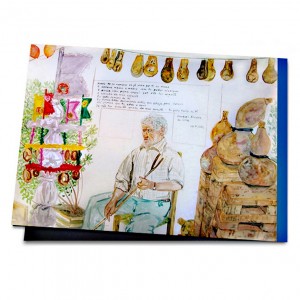
For more than thirty years, every July the small town of São Teotónio in southwest Portugal has hosted FACECO, the most important trade and cultural fair in the Alentejo region. Between livestock exhibitions, handicrafts, gastronomy and music, the fair is filled with colourful, lively activity that attracts visitors from near and far. I had been there many times as a visitor. One day, the idea came to me not only to look, but also to paint. An artist, a musician, a craftsman – I did not yet know who would become my subject.
Senhor Amavel immediately caught my eye. He was sitting on a low stool right at the entrance to the handicrafts hall, carving a long stick, completely unfazed by the bustle of people around him. Beside him were stacks of cork stools in different sizes and unusually shaped gourds; behind him hung round-bellied cork ladles from a long cord. An ornately decorated post stood next to his stall like a small, colourful maypole. The whole scene seemed to belong to another time. I had found my subject!
“May I paint you?” I asked, pointing to my large watercolour pad. The old man nodded in surprise but agreed. Apparently, he was just as puzzled as the friends and acquaintances who stopped by from time to time and asked, “Why is she doing that?” He usually responded with a helpless shrug of the shoulders. How could he have known that, back then, I was passionate about painting people at work?
Around midday, the hall began to empty. Senhor Amavel disappeared for a long lunch break and I used the quiet time to capture the many details of his stall – the distinctive shapes, the warm tones of the cork and the intricate carvings. When he returned, my painting was finished. Not without pride, I showed it to him. He looked at it for a long time. Then he slowly pulled a folded piece of paper from his trouser pocket and handed it to me. Wordlessly. Questioningly.
On the paper was a handwritten text. With a gesture he indicated that he wanted it written onto the painting, there in the middle. It was a small, deeply personal poem, a declaration of love to his late wife. Of course I could do that. With brush and paint, I wrote his words into the picture. The old man’s face lit up when he took the painting pad into his hands afterwards. I could sense that the painting suddenly meant much more to him. “For me?” he asked unexpectedly. I was surprised, but hesitated only briefly before replying, “Yes – but not today.”
Although I almost always keep my originals, I knew in that moment that this painting belonged to him. First, I took it back to Germany to scan and archive it. In autumn, I brought it back to Portugal. All I knew was that Senhor Amavel lived somewhere outside the coastal town of Vila Nova de Milfontes. So I began to search. Eventually, in a street café, I met someone who knew him and could give me directions. The old man was clearly surprised when I appeared at his front door, and delighted when I handed him the painting. Framed and mounted. He immediately gave it a prominent place above the sofa in his living room.
Afterwards, Senhor Amavel showed me his workshop. Under a corrugated metal roof between the house and an outbuilding, thick cork oak bark was stacked high. Tools stood everywhere; cut cork sheets and half-finished pieces lay all around. I already knew that cork stripped by hand must rest for months before it can be worked. I also knew that the bark is straightened with steam. But only now could I truly imagine how much experience and patience it takes to turn it into ladles, stools or trivets. It was a fascinating insight into a centuries-old Portuguese craft.
From the many ladles and pot stands on his long workbench, I was invited to choose whatever I liked. Then Senhor Amavel gave me a beautifully carved wooden sun. With a mischievous smile, he explained that it was not finished yet. I should complete it myself. Just as he had given my painting his own personal signature through his poem.