
 MAJOBA on Facebook


November 2026
- The Sky Above Berlin -
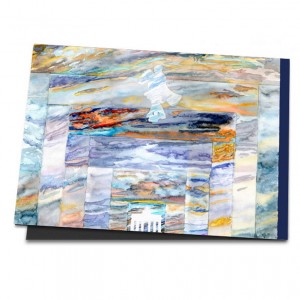 When I decided, many years ago, to become a painter – a plein-air painter, to be precise – I naturally had big plans. I dreamed of large-scale watercolours, exhibitions and selling my original paintings. Miniatures, painting on my travels, arts and crafts markets, reading magnets and booklets filled with stories were certainly not part of the picture back then.
The annual Querschnitt art exhibition, held every November at the Statthaus Böcklerpark, seemed like the perfect way to dip my toes into the art world. Anyone from Kreuzberg could take part, with just one piece of work. I set myself a special challenge. Until then, I had always painted with the awareness that each picture anchored me to a particular place at a particular moment in time. But this time, I wanted to express my relationship with Berlin. The city itself would be represented neutrally, almost schematically, by the Brandenburg Gate. Above it: the sky – different every evening, always on the move, constantly changing. And in the upper centre, the colourful silhouette of a dancing couple: my symbol of a lasting moment of happiness.
Armed with this idea, I divided my watercolour pad into sections. Over the following evenings, just before sunset, I headed down to the Landwehr Canal, where I painted the sky above Urbanhafen in two vertical panels joined by a horizontal one. It was early November. The sun disappeared early, and summer was long gone. The wind swept across the water, shook the last leaves from the trees and rushed straight up my trouser legs. I had to fight to keep hold of my painting pad and paintbox. But I stayed. Evening after evening, for a whole week, I stood there watching the sky, mixing colours and trying to capture that one fleeting moment before it vanished once more. By the time I finally packed up my things, my fingers were stiff with cold. Thoroughly frozen, I would creep home to the warmth of my own four walls after each painting session.
When I finally saw my painting hanging among all the other pictures, sculptures and installations at the exhibition opening, I was happy. A wonderful start to my life as an artist, I thought. I had challenged myself, and that evening I felt at peace with myself and the world. A few days later, I received a call from the exhibition organisers. Someone was interested in buying my painting. “You should be pleased,” they told me. “He’s a collector.” Well. By then, it was already too late. I had long since decided that I didn’t want to sell this painting. It belonged to me. To my husband. To our life in Berlin. I simply couldn’t bring myself to let it go – and apparently, my artist’s soul wasn’t having it either. Plein-air painting is a very personal thing. I don’t simply paint a place. I’m there. Right in the middle of it all. I take in everything happening around me: the light, the sky, the people. I experience that moment with all my senses, and something of it stays behind in my painting.
“Exhibiting your work without wanting to sell it? That’s just not how it’s done. I’ll never make it as an artist,” I thought at the time. Or perhaps I would? That phone call turned out to be more important than I realised. It made me understand that, for me, a plein-air painting is more than a work of art that changes hands after an exhibition. It holds a little piece of my experience, a moment I feel connected to. There had to be another way. I just didn’t know what it would look like yet.